Over the last eight years in business, we at TheCodeWork have encountered one simple truth when we started to develop a Manufacturing ERP Software (ERPKaro). That is, most manufacturing businesses in India do not start with an ERP. They start with Excel. A few sheets for production planning, one for inventory, another for purchase orders, and a master file that the owner checks every morning.
The thing is, for a while, this works well. Then the order book gets heavier, the product mix widens, and the same spreadsheets that once gave control start hiding problems.
The shift is rarely obvious. There is no single day when Excel stops working. Small delays, stock mismatches, and missed commitments pile up until they feel normal. By the time the cost shows up in the Profit and loss books, the business has been leaking output and margin for months. And thus we started our own research to build a Manufacturing ERP Software (ERPKaro) in India.
So this is a sign. If you are still running your factory on spreadsheets, let’s talk. Book a free ERP Readiness assessment to see where manual planning is secretly costing you output and control.
Understanding the Problem

Spreadsheets are personal tools used for a shared job. Each file lives on one machine, reflects one person’s view, and updates only when someone remembers to update it. On a small floor, that is manageable. As volume grows, the gap between what the sheet says and what is actually happening on the floor widens.
The root cause is not Excel itself. It is that production, stores, purchase, and accounts each keep their own version of the truth. No two versions fully agree, so people spend their day reconciling numbers instead of acting on them.
Why Excel Dependency Becomes Expensive?
The cost shows up across the operation, not in one place.
Production planning slips because the plan is built on stock figures that are already out of date. Inventory carrying cost rises as teams over-order to stay safe, while fast-moving items still run short. Procurement turns reactive, with emergency purchases at higher prices. Delivery commitments become guesses, which erodes customer trust. Finance closes the month late because the underlying data never quite ties out.
Industry benchmarks vary, but inventory carrying cost commonly sits in the range of twenty to thirty percent of inventory value per year. When stock accuracy is low, that cost climbs without anyone noticing.
7 Signs Your Factory Has Outgrown Excel, and You Need a Manufacturing ERP Software
- The same data is entered more than once. A purchase order is typed into one sheet, then re-typed into stores and again into accounts.
- No one fully trusts the stock figure. Teams physically check the store before committing to an order.
- Planning depends on one person. When that person is on leave, the schedule stalls.
- You find problems after they happen, not before. A shortage is discovered on the line, not during planning.
- Reports are always a day or two old. By the time a report is ready, the situation has already changed.
- Month-end reconciliation takes longer every quarter as volume grows.
- Growth feels like it needs more coordinators rather than more capacity. You are adding people to move data, not to make product.
If three or more of these are familiar, the spreadsheet model is now limiting the business rather than supporting it.
How Growing Manufacturers Move Beyond Spreadsheets
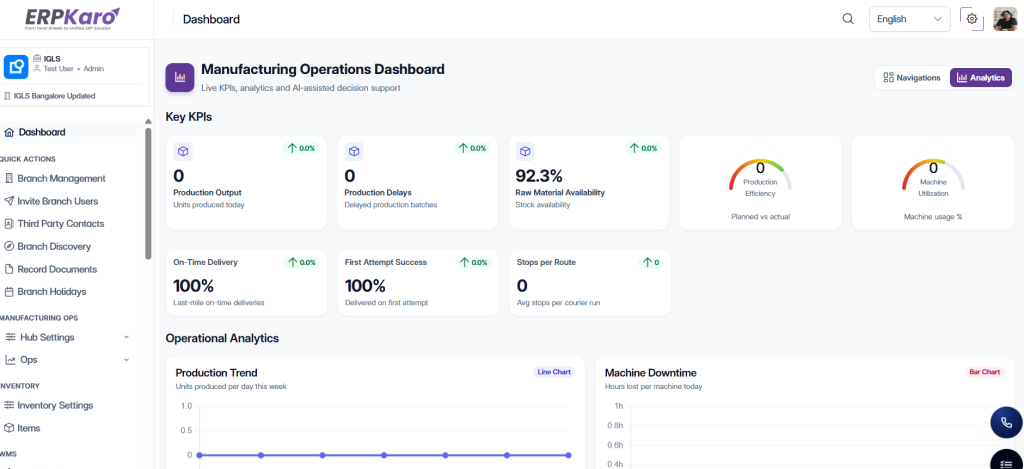
The fix is not more sheets or stricter templates. It is a single, shared record of what is happening across the factory, updated as work actually moves.
Leading manufacturers connect planning, stores, purchase, and the shop floor so that one update is visible everywhere. They standardize how an order flows from sales to dispatch, so the process does not depend on one person’s memory. They shift from checking the past to planning the next few days with confidence.
Want to find the hidden inefficiencies in your current setup before you commit to anything? Schedule a consultation with our manufacturing ERP specialists.
How a Manufacturing ERP Software like ERPKaro help?
A manufacturing ERP software like ERPKaro replaces the scattered sheets with one connected system. Production planning works from live stock and order data, so the plan reflects reality. Material requirement planning calculates what to buy and when, which cuts emergency purchasing. Inventory updates as goods move, so the stock figure can be trusted. Shop floor visibility shows work-in-progress without a manual status call.
ERPKaro is built for small and mid-sized manufacturers, with AI-powered production planning, MRP, inventory management, and analytics in one place. The point is not the software. It is that decisions stop waiting for someone to reconcile a file.
A Realistic Manufacturing Example
Consider a mid-sized fabrication unit running two shifts, planning entirely in Excel.
Before: stock accuracy hovered near seventy percent, emergency purchases ran several times a week, and on-time delivery sat around seventy-five percent.
Problems: planners rebuilt the schedule daily because stock numbers were wrong, and the owner reviewed a master sheet every morning to catch issues.
Actions taken: the unit moved planning, stores, and purchase onto one system, with stock updating as material moved.
Results: within a couple of cycles, stock accuracy rose past ninety percent, emergency purchases dropped sharply, and planners spent their time on the next order instead of correcting the last one. These figures are illustrative of the pattern most factories see, not a fixed promise.
Key Metrics Every Manufacturing Owner Should Track
- Inventory accuracy
- Inventory turnover and carrying cost
- On-time-in-full delivery
- Production efficiency and capacity utilization
- Work-in-progress levels
- Procurement lead time and emergency purchase frequency
Key Takeaways
Excel is a starting point, not a growth platform. The real cost of staying manual is not the tool, it is the time spent reconciling, the stock you cannot trust, and the orders you cannot reliably commit to. The signs above are early warnings, visible long before the damage reaches the balance sheet.
Conclusion
Spreadsheets do not fail loudly. They quietly cap how large and how reliable a factory can become. As a manufacturer grows, the gap between the sheet and the floor widens, and the business pays for that gap every month.
If inventory mismatches, production delays, or planning that depends on one person are slowing your growth, book a personalized ERPKaro demo to see how manufacturers gain better visibility and control over daily operations.
Frequently Asked Questions
Is Excel really a problem for a manufacturing business?
Excel is fine for early-stage tracking. It becomes a problem once multiple people update the same data, stock figures stop matching the floor, and planning depends on one person’s files. At that point the errors cost more than the tool saves.
When should a manufacturer move from Excel to an ERP?
A practical trigger is when reconciling production, stores, and accounts takes longer every month, or when you discover problems after they happen instead of before. If growth needs more coordinators rather than more capacity, it is time to evaluate an ERP.
Will moving off spreadsheets disrupt daily production?
A phased rollout, starting with inventory or production planning, keeps disruption low. Most small and mid-sized manufacturers run the ERP alongside existing processes for a short period before switching fully.
How long does a manufacturing ERP take to implement in India?
Implementation timelines vary with scope and data readiness. Focused rollouts for small and mid-sized manufacturers are typically faster than full multi-module projects. ERPKaro is built for fast implementation, so teams see value early.
What should we measure to know the move worked?
Track inventory accuracy, on-time-in-full delivery, planning time per cycle, and how quickly month-end reconciliation closes. Improvement in these four numbers is a clear sign the system is working.
Related reading
Still running your factory on spreadsheets? Book a free ERPKaro assessment to see where manual planning is quietly costing you output and margin.