Ask most factory owners what poor production planning costs them, and the honest answer is that they do not know. The losses do not arrive as a single invoice. They are spread across overtime, rush freight, idle machines, excess stock, and the occasional order that slips to a competitor. Each looks small on its own. Together, they often add up to more than the profit on a good month.
The reason this stays invisible is simple. Planning happens in spreadsheets and conversations, so there is no clean record of what the plan was, what changed, and why. Without that record, the cost of changing the plan ten times a week never gets measured.
If you are still planning production in spreadsheets, let’s have a brief chat with our expert team at ERPKaro. We will help you estimate your monthly impact and see how manufacturers reduce delays and idle time.
Understanding the Problem
Production planning is the decision about what to make, in what order, on which machine, with what material, and by when. When that decision is made well, the floor flows. When it is made on stale data, every downstream team pays for it.
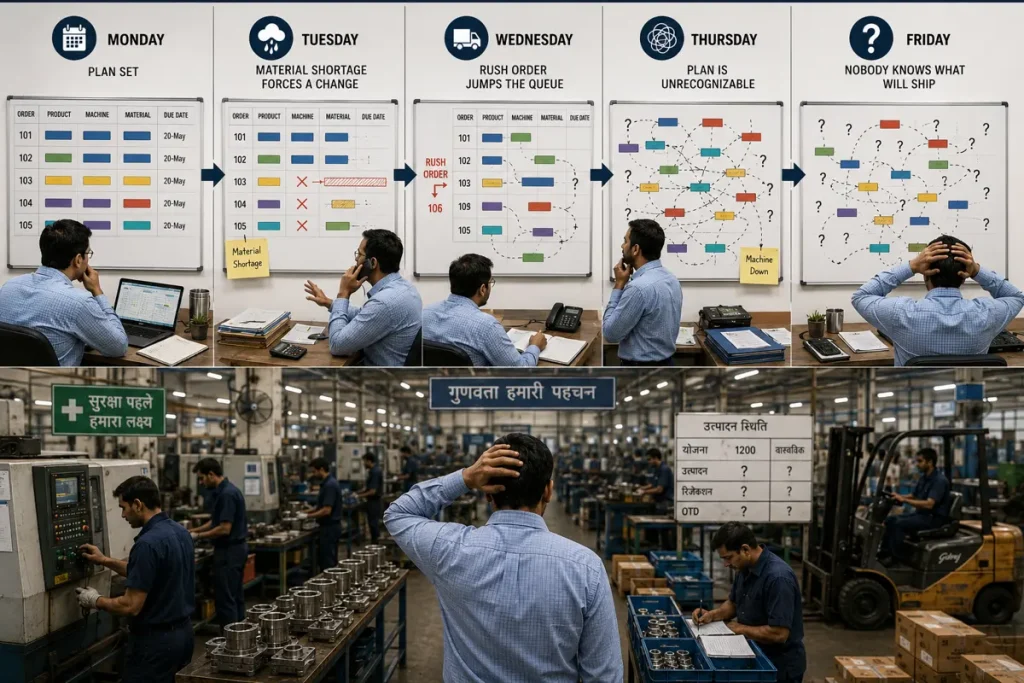
The common pattern looks like this. A plan is set for Monday. By Tuesday, a material shortage forces a change. And by Wednesday, a rush order jumps the queue. By Thursday, the original plan is unrecognizable, and nobody can say what the factory will actually ship on Friday. The plan is not wrong because the planner is careless. It is wrong because it was built on numbers that were already out of date.
Why This Problem Becomes Expensive Over Time?
The cost compounds across the operation.
- Production impact: machines sit idle waiting for material or setup, then run overtime to catch up. The capacity that you paid for is not converted into output.
- Inventory impact: to protect against shortages, teams hold more safety stock than needed, which ties up working capital. At the same time, the wrong items still run short.
- Procurement impact: when the plan shifts constantly, purchase becomes reactive. Emergency buying at higher prices and premium freight becomes routine.
- Customer impact: delivery dates become estimates rather than commitments. Late deliveries erode trust and put repeat orders at risk.
- Financial impact: all of the above land on the P&L as higher cost and lower throughput, often without a clear cause anyone can point to.
Industry benchmarks vary by sector, but it is common for unplanned idle time and rescheduling to quietly consume a meaningful share of available capacity each month. Even a small recovered percentage of capacity is significant when the machines are already paid for.
Warning Signs Manufacturing Leaders Should Watch For:
- The schedule is rebuilt almost every day.
- Overtime is routine, not exceptional.
- Emergency purchases happen weekly.
- Machines wait for material while other machines sit on work nobody needs yet.
- Delivery promises are made without checking real capacity.
- The owner or plant head is the single point of coordination.
How Leading Manufacturers Address This Challenge?
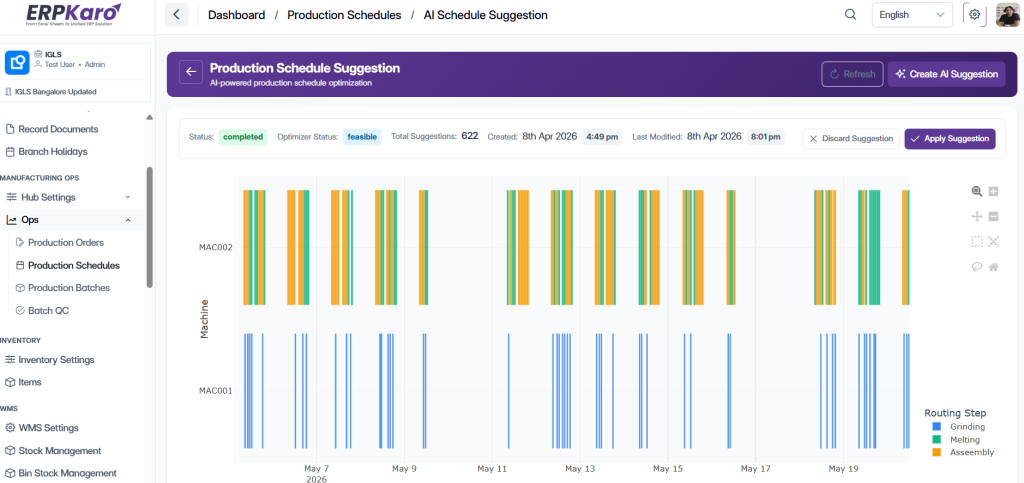
Strong planning is less about working harder and more about planning from reality. Leading manufacturers build the schedule on live stock and capacity, not on yesterday’s snapshot. They sequence work to reduce changeovers and keep bottleneck machines fed. They give the floor a clear, current view of what to run next, so the plan does not live only in the planner’s head.
The result is fewer changes, steadier output, and far less firefighting.
Want to see where idle time and rescheduling are hiding in your process? Schedule a consultation with our manufacturing planning specialists.
How Technology and ERP Systems Help?
A manufacturing ERP turns planning from a daily rebuild into a controlled process. Production planning works from live inventory and order data, so the plan holds longer. Material requirement planning calculates exactly what to buy and when, which removes most emergency purchasing. Scheduling considers capacity and sequence, so machines stay fed. AI-powered planning helps anticipate conflicts before they reach the floor.
ERPKaro brings production planning, scheduling, MRP, and inventory into one system built for small and mid-sized manufacturers. The benefit is not a dashboard. It is that the plan you set in the morning is still valid in the afternoon?
A Realistic Manufacturing Example
Consider a machinery component manufacturer running a single plant.
Before: the schedule changed daily, overtime ran high, and on-time delivery sat near seventy percent.
Problems: planners spent most of their day reacting to shortages, and the plant head approved rush purchases several times a week.
Actions taken: the manufacturer moved planning, inventory, and purchase onto one system, with MRP driving material timing.
Results: schedule changes fell, overtime dropped, and on-time delivery climbed into the high eighties over a few months. Recovered idle capacity let the plant take on additional orders without new machines. These numbers illustrate the typical direction of improvement rather than a guaranteed outcome.
Key Metrics Every Manufacturing Leader Should Track
- Production efficiency and capacity utilization
- Unplanned machine idle time
- Schedule adherence and number of plan changes
- On-time-in-full delivery
- Overtime hours tied to rescheduling
- Emergency purchase spend
Key Takeaways
Poor planning is expensive precisely because it is hard to see. The losses live in overtime, idle time, rush buying, and missed orders, not in a single line item. Estimating those four or five numbers is the first step toward controlling them.
Conclusion
Production planning is one of the highest-leverage decisions in a factory. When it is made on stale data, the cost spreads quietly across every team and grows as the business grows. Acting early, while the losses are still recoverable, is far cheaper than absorbing them month after month.
If delays, idle capacity, or constant rescheduling are eating your margin, book a personalized demo to see how manufacturers plan with confidence.
Frequently Asked Questions
What does poor production planning actually cost?
The cost rarely appears as one line item. It hides in overtime, expedited freight, idle machines waiting for material, excess safety stock, and lost orders from late delivery. Added together across a month, these often exceed the cost of the planning tool that would prevent them.
How do I estimate planning losses for my factory?
Start with four numbers: hours of unplanned machine idle time, monthly emergency purchase spend, overtime tied to rescheduling, and the value of orders delivered late. Even rough figures reveal the scale and where to focus first.
Is production planning software only for large factories?
No. Small and mid-sized manufacturers often gain the most, because they feel every delay directly. Affordable, fast-to-implement systems exist specifically for this segment.
Will better planning reduce overtime?
Usually yes. A large share of overtime comes from reacting to schedule changes and material shortages. When the plan is built on live data, the firefighting that drives overtime falls.
How quickly can planning improve after adopting software?
Many factories see steadier schedules within the first few planning cycles, because the plan finally reflects real stock and capacity. Larger gains in delivery and utilization build over the following months.
Related reading
Not sure what poor planning is costing you? Use the ERPKaro losses calculator to estimate your monthly impact, then book a demo to close the gap.