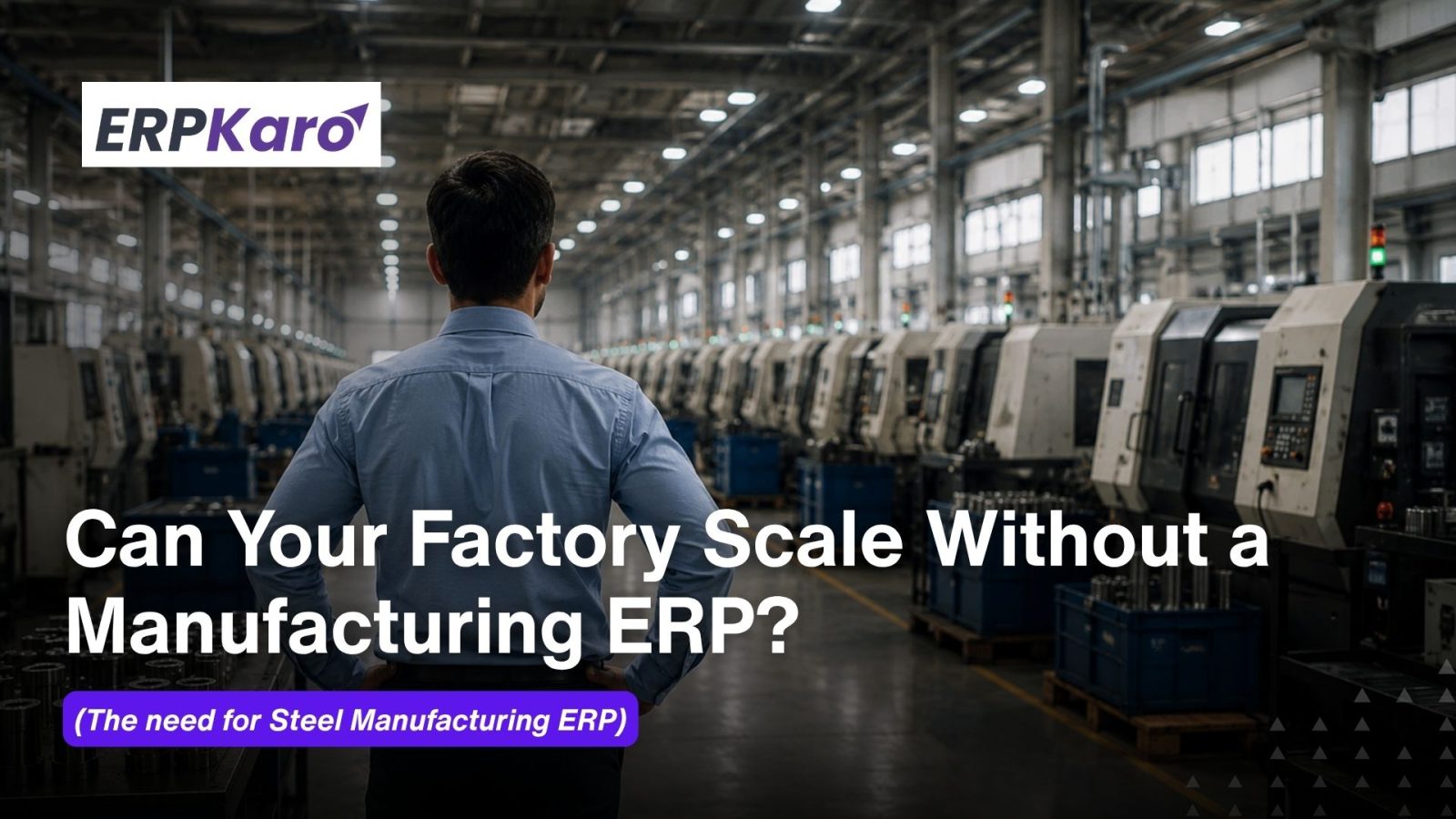
Most factories grow on the strength of a few people who know how everything works. The senior planner who carries the schedule in his head. The storekeeper who knows where every part is. The owner who reviews the whole operation each morning and catches problems before they spread. This works remarkably well, until it does not. The moment a business tries to double its output, the very people who made growth possible become the limit on it. In such situations, we need to ask the question: Can Your Factory Scale Without a Manufacturing ERP?
The hard question for a manufacturing owner is this: can the factory run correctly when you are not watching, and when the people who hold it together are stretched thin? If output depends on memory rather than process, the honest answer is no. Growth does not just add volume. It exposes every place where the factory depends on a person instead of a repeatable way of working.
Is your factory ready to grow, or is growth waiting on you? Request an ERPKaro demo to see where unstandardized processes will cap your scale.
Understanding the Problem of Functioning without a Manufacturing ERP
A standardized process is a defined, repeatable way a task is done, no matter who does it. An order flows from sales to dispatch through the same steps, with the same owners and the same records, every time. The opposite is a factory where each order is handled a little differently, depending on who picks it up and how busy they are.
Unstandardized factories are not disorganized. They are usually run by capable people who have absorbed the process into their own judgment. That is exactly the problem. The process lives in their heads, not in the business. When volume is low, a few experts can hold it all together. As volume rises, the variation between how different people work multiplies faster than anyone can manage.
The root cause is dependence on individuals. When knowledge is personal rather than shared, the factory cannot reliably reproduce its own good days.
Why Does This Problem Become Expensive Over Time?
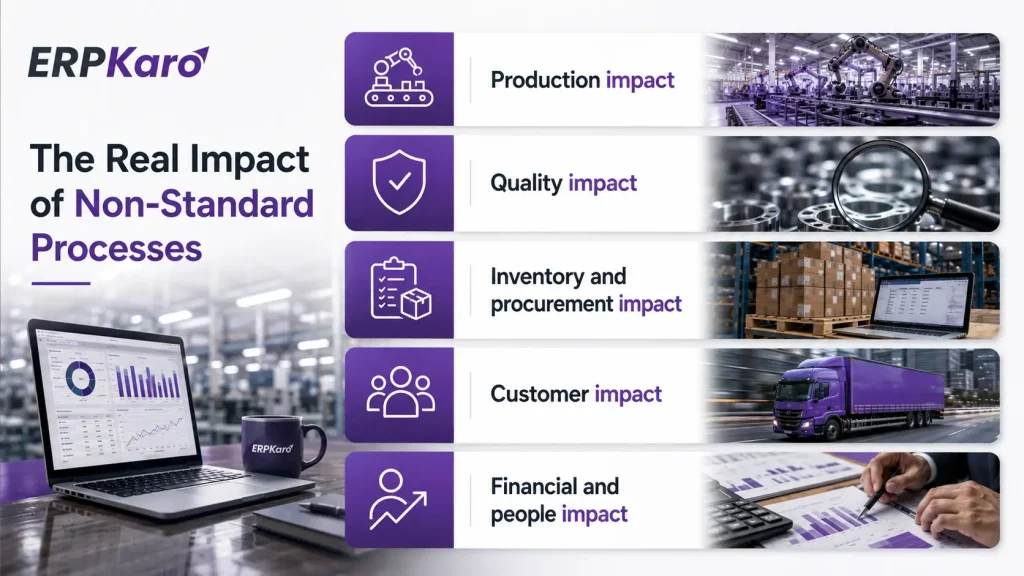
A people-dependent factory pays for the gap as soon as it tries to grow.
- Production impact: without a standard flow, planning depends on a few experts. When they are stretched or absent, schedules slip, and the line waits.
- Quality impact: variation in how each order is handled produces variation in output. Rework and rejections rise as volume grows.
- Inventory and procurement impact: with no standard way to record stock and trigger purchasing, accuracy falls, and emergency buying rises, exactly the failures that compound under higher volume.
- Customer impact: inconsistent processes mean inconsistent delivery, which erodes on-time-in-full performance and trust just as the order book grows.
- Financial and people impact: the owner stays trapped in daily firefighting, and growth needs more coordinators to move information rather than more capacity to make product. The cost is paid in the owner’s time and in capped output.
Warning Signs Manufacturing Leaders Should Watch For
- The factory runs well only when specific people are present.
- The owner still reviews daily operations to catch problems.
- Each order is handled a little differently depending on who picks it up.
- Training a new hire means months of shadowing, not a documented process.
- Quality and delivery vary with workload rather than staying stable.
- Growth is adding coordinators to manage information, not capacity.
How Leading Manufacturers Address This Challenge?
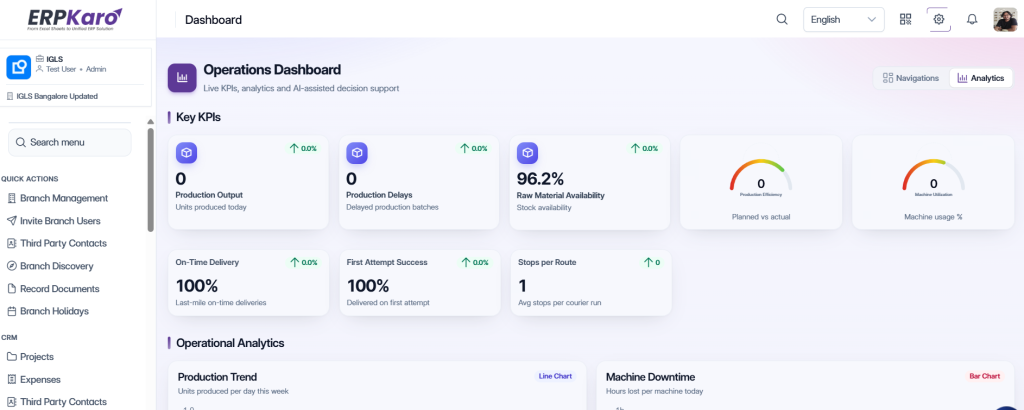
Manufacturers who scale safely standardize before they grow, not after.They define how an order flows from sales to dispatch, with clear steps, owners, and records, so the process does not depend on one person’s memory. Once established, the standard becomes the default way work happens and can then be improved deliberately, with the confidence that each improvement will repeat reliably.
They also separate two things owners often confuse. First, they standardize the right way to do a task. Then they automate that defined way so it runs consistently at higher volume. Automating before standardizing only produces the wrong result faster. The order matters.
If you want to know which processes are ready to scale and which will break first, request an ERPKaro demo for the same.
How Technology and ERP Systems Help?
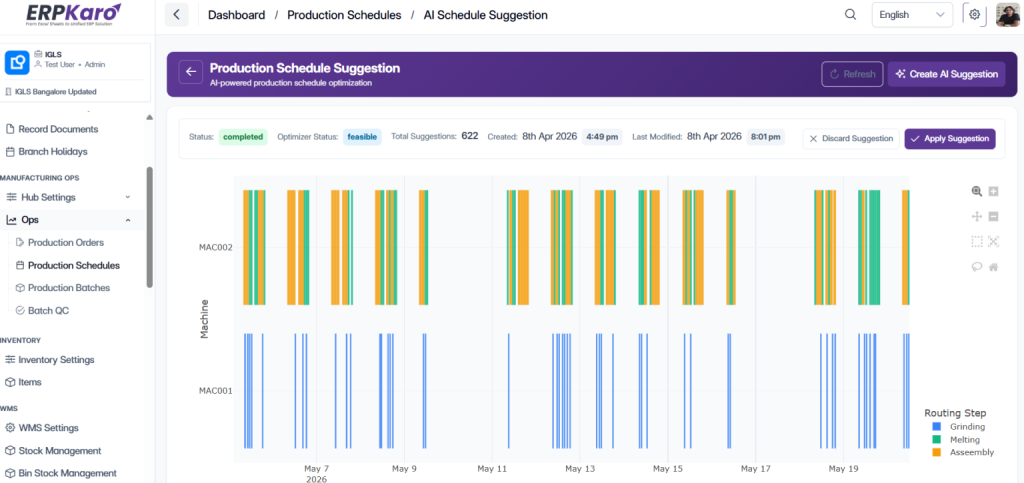
Manufacturing process automation, delivered through an ERP, encodes the standard flow into the way work happens. Every order follows the same steps, owners, and records by default, so output stops depending on memory. Production planning, inventory, purchasing, and the shop floor share one connected record, so an update is visible everywhere. Data is captured as work moves, which gives the owner visibility across the whole operation without a daily review.
ERPKaro brings AI-powered production planning, inventory management, work order management, and analytics into one system for small and mid-sized manufacturers. The point is not the software. It is that the factory can run correctly at scale without depending on a handful of people holding it together.
A Realistic Manufacturing Example
Consider a mid-sized engineering workshop trying to double output after winning a large contract.
- Before: the schedule lived with one planner, stock control depended on the storekeeper, and the owner reviewed operations every morning.
- Problems: when key people were stretched, schedules slipped, and quality varied. Growth was adding coordinators, not capacity, and the owner could not step back.
- Actions taken: the workshop defined a standard order-to-dispatch flow, moved planning, stores, and the floor onto one connected system, and automated the standard steps.
- Results: over two quarters, output rose without proportional headcount, quality steadied, and the owner moved from daily firefighting to managing growth. These figures illustrate the typical pattern rather than a guaranteed result.
Key Metrics Every Manufacturing Leader Should Track
- Process consistency (share of orders following the standard flow)
- On-time-in-full delivery
- Production efficiency and capacity utilization
- Rework and rejection rate
- Output per employee as volume grows
- Time the owner spends on daily firefighting versus planning
Key Takeaways
A factory built on people, not process, can grow until the people run out of capacity, and no further. Standardization turns personal knowledge into a repeatable business asset, which is what makes scaling possible. Standardize first, then automate the standard, so growth adds capacity instead of chaos. The earlier this is done, the cheaper and smoother the next phase of growth becomes.
Conclusion
Scale rewards predictability and punishes variation. A factory that depends on memory can deliver brilliant days, but not consistent ones, and growth needs consistency above all. As volume rises, the gaps that capable people quietly cover today turn into the limits on tomorrow’s output.
If growth is starting to depend on you rather than your systems, request an ERPKaro personalized demo to see how manufacturers standardize and scale without losing control.
Frequently Asked Questions
What does a standardized process actually mean in a factory?
A standardized process is a defined, repeatable way a task is done regardless of who does it. An order flows from sales to dispatch the same way every time, with clear steps, owners, and records. Standardization makes output predictable and reduces dependence on individual memory.
Why do unstandardized factories struggle to scale?
When processes live in people’s heads, every new order, person, or shift introduces variation. Quality drifts, planning depends on a few experts, and the owner becomes the system. Growth multiplies the variation faster than the team can manage it, so scaling stalls.
Does standardization make a factory rigid?
No, when done well it does the opposite. A standard process is a stable base you can improve deliberately and repeat reliably. Without a standard, every improvement is a one-off that fades. Standardization makes change manageable rather than chaotic as volume rises.
How is standardization different from automation?
Standardization defines the right way to do a task. Automation uses systems to run that defined way consistently and at scale. You standardize first so you automate the correct process. Automating a broken process simply produces the wrong result faster.
How does an ERP support standardized processes?
An ERP encodes the standard flow so every order follows the same steps, owners, and records by default. It removes reliance on memory, captures data automatically, and gives the owner visibility across the whole operation, which is what makes scaling without chaos possible.
Related reading
Is your factory ready to grow, or is growth waiting on you? Request an ERPKaro ERP readiness assessment to see where unstandardized processes will cap your scale.