
Inventory accuracy in manufacturing companies takes care of itself. One storekeeper knows every shelf, every part, and roughly how much of each is on hand. The system figure and the physical figure stay close because one person sees both. Then the business grows. More orders, more locations, more people touching stock, and more variety. Quietly, the system figure and the physical figure start to drift apart.
By the time a growing factory measures it, inventory accuracy has often fallen below eighty percent. That number matters because it sets a ceiling on everything else. Planning, purchasing, and delivery all depend on trusting the stock figure, and below eighty percent, no one does. Teams start counting the store before committing to an order, which is the clearest sign that the records have stopped being useful.
Not sure how accurate your stock records really are? Request an ERPKaro demo to measure the gap before it costs you another quarter.
Understanding the Problem of Inventory Accuracy in Manufacturing Companies
Inventory accuracy in manufacturing companies is the match between what the system says you have and what is physically on the shelf. It falls when movements happen faster than they are recorded.
Picture a single shift in a growing unit. Material is issued to the line, some is returned, a few items are moved between locations, scrap is set aside, and a customer return comes back into stores. In a small operation, the storekeeper logs all of this. In a larger one, some of it gets recorded late, some gets recorded wrong, and some is never recorded at all. Each gap is tiny. Across thousands of transactions a month, they add up to a record that no longer matches reality.
The root causes are structural, not personal. Manual entry cannot keep pace with rising transaction volume. Multiple people record stock with no single shared system. There is no routine count to catch errors early, so mistakes compound until the annual stocktake reveals a large gap that no one can explain.
Why This Problem Becomes Expensive Over Time?
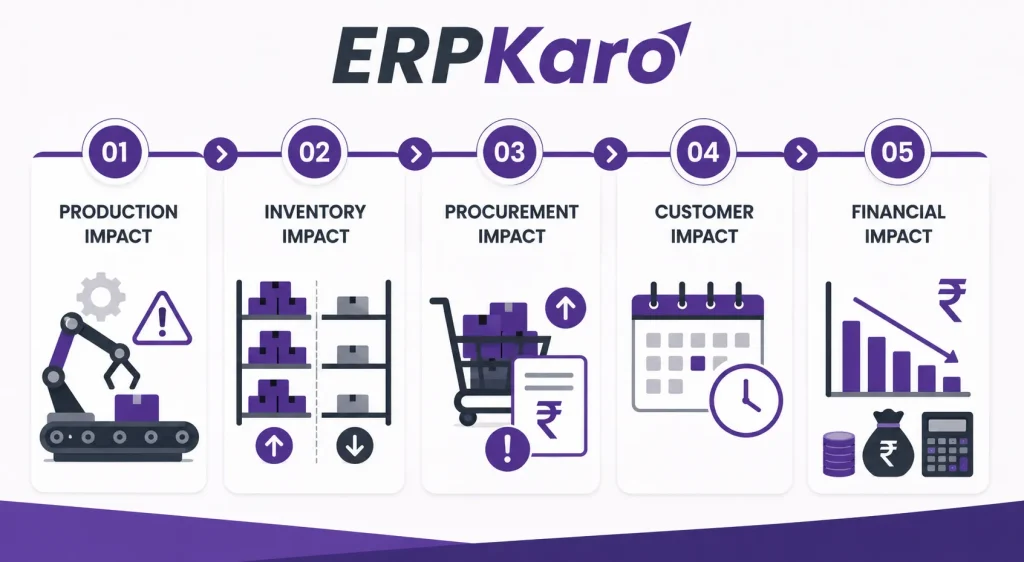
Inaccurate stock quietly raises costs across the whole operation.
- Production impact: planning built on the wrong figures creates shortages on the line. Machines and labor sit idle while procurement scrambles for a part that the system claimed was in stock.
- Inventory impact: to feel safe, every team adds a private buffer. The factory ends up overstocked and short at the same time, holding cash in the wrong items.
- Procurement impact: buyers cannot trust the figure, so they over-order or place emergency purchases at premium prices.
- Customer impact: shortages push out delivery dates, which erodes on-time-in-full performance and customer confidence.
- Financial impact: write-offs at year’s end grow as unrecorded losses and dead stock surface together. Finance cannot close the month cleanly because the inventory number never quite ties out.
Warning Signs Inventory Leaders Should Watch For
- Teams physically check the store before committing to an order.
- The annual stocktake reveals a large, unexplained variance.
- Shortages appear on the line for items the system showed as available.
- Stock movements are recorded hours or days after they happen.
- More than one person updates the stock with no shared record.
- Reorder points trigger late or not at all because the figure is wrong.
How Leading Manufacturers Address This Challenge?
Manufacturers who keep accuracy high do not rely on memory or on one person. They record movements at the point they happen, so the system reflects the floor in near real time. They use cycle counting, rotating through a sample of items continuously, to catch errors within days rather than at year end. They define clear locations and item codes so the same part is logged the same way every time.
Most importantly, they treat accuracy as a measured metric with a target, reviewed regularly, rather than something assumed to be fine until the stocktake proves otherwise.
If you want a clear, item-level measure of where your accuracy is leaking, request an ERPKaro demo.
How Technology and ERP Systems Help?
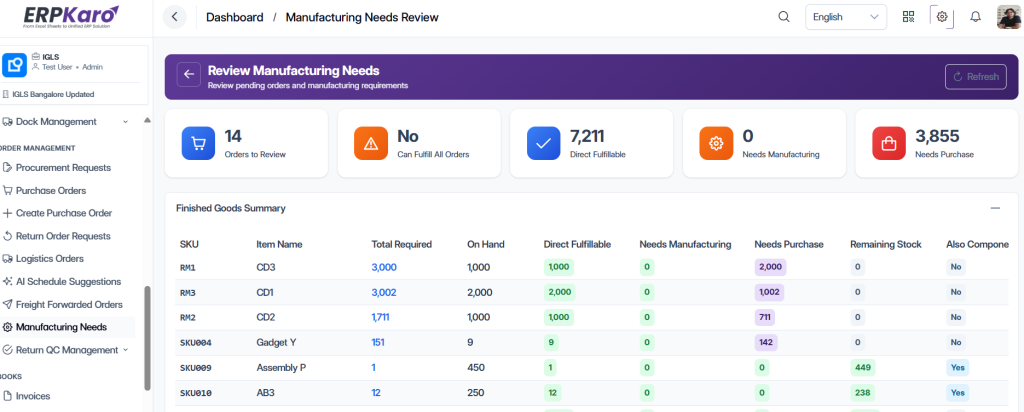
An inventory control system removes the manual recording gap that destroys accuracy. Stock updates as material is issued, returned, moved, or received, so the system stays close to physical reality. Barcoding and location tracking cut entry errors. Cycle counting tools schedule and record rotating counts, so variances are found early. Analytics flag items with persistent mismatches so attention goes where it is needed.
ERPKaro brings inventory management, MRP, and analytics into one system for small and mid-sized manufacturers. For an inventory manager, the outcome is a stock figure that the whole factory can finally trust, which makes planning, purchasing, and delivery reliable again.
A Realistic Manufacturing Example
Consider a mid-sized plastics manufacturer that grew from one location to three.
- Before: inventory accuracy had fallen to roughly seventy-five percent, the annual stocktake produced a large variance, and planners no longer trusted the system figure.
- Problems: shortages appeared for items shown as in stock, teams held private buffers, and write-offs were rising at year end.
- Actions taken: the manufacturer recorded movements at the point of action, introduced cycle counting on high-value items, and standardized item codes and locations.
Results: over two quarters, accuracy rose past ninety-five percent, line shortages fell, and finance closed the month with far less reconciliation. These figures illustrate the typical pattern rather than a guaranteed result.
Key Metrics Every Inventory Leader Should Track
- Inventory accuracy (physical versus system)
- Cycle count variance by item value class
- Stockout frequency on fast-moving items
- Dead stock and aging (share unmoved in ninety days)
- Inventory turnover
- Time taken to close month-end inventory reconciliation
Key Takeaways
Inventory accuracy does not fall because people get careless. It falls because manual recording cannot keep pace with growth. Below eighty percent, the stock figure stops being usable, and every downstream decision suffers. The fix is recording movements as they happen, counting continuously rather than once a year, and treating accuracy as a measured target.
Conclusion
Accuracy is the foundation that planning, purchasing, and delivery all stand on. As a factory grows, transaction volume rises faster than manual systems can handle, so the gap widens every quarter unless something changes. The earlier the accuracy is fixed, the cheaper it is, because the errors compound with scale.
If you suspect your stock records have drifted from reality, request an ERPKaro demo and talk to our team to see how manufacturers rebuild a stock figure they can trust.
Frequently Asked Questions
What is a good inventory accuracy level for a factory?
Well-run manufacturers aim for inventory accuracy above ninety-five percent, measured as the match between physical and system stock. Below eighty percent, planning becomes unreliable and teams stop trusting the numbers. The right target depends on item value and how tightly production is scheduled.
Why does accuracy fall as a factory grows?
Growth adds transactions, locations, people, and product variety. Manual recording cannot keep pace, so small unrecorded movements accumulate. Each missed issue or unlogged return widens the gap between the system figure and physical stock until accuracy drops below a usable level.
How do I measure inventory accuracy?
Count physical stock for a sample of items and compare it to the system figure. Accuracy is the share of items where physical and system match within an acceptable tolerance. Cycle counting a rotating sample is more practical and reliable than one large annual count.
Does low inventory accuracy really affect production?
Yes. Planning built on wrong stock figures creates shortages and excess at the same time. The line stops for parts the system said were available, while cash sits in items nobody needs. Low accuracy is one of the most common hidden causes of production delays.
How does an inventory control system improve accuracy?
It captures movements as they happen, so the system reflects the floor in near real time. Barcoding, location tracking, and cycle counting reduce manual error. With fewer recording gaps, accuracy rises and teams can finally trust the stock figure for planning.
Related reading
Not sure how accurate your stock records really are? Request an ERPKaro inventory health check to measure the gap and see where accuracy is leaking.