A steel plant head is constantly asked one question: Can we make more? The usual answer is to look at the furnace, the rolling mill, or the order book. The more uncomfortable answer is that much of the missing capacity already exists inside the plant. It is simply being lost, shift after shift, to poor scheduling. And this is exactly why they need a Steel Manufacturing ERP.
Capacity rarely disappears in one dramatic event. It leaks in changeovers that take longer than they should, furnaces idling between heats, material that arrives late to the line, and jobs run in an order that forces avoidable rework. Each loss looks small. Added together across a month, they can equal a production line the plant never built.
If you suspect your plant is leaving capacity on the table, schedule an assessment with ERPKaro to find how many hours each shift are lost to sequence rather than to machines.
Capacity Loss due to Poor Scheduling
Steel manufacturing is particularly sensitive to poor scheduling, and that is why you need a Steel Manufacturing ERP. Grade changes, section changes, and heat sequencing all carry real penalties in time and yield. Switching from one grade to another may require purging, temperature changes, roll changes, and fresh quality checks. Sequence the jobs well, and you pay that penalty rarely. Sequence them poorly, and you pay for it again and again.
The root cause is usually a schedule built without a true picture of constraints. When a plan is assembled by hand on yesterday’s data, it cannot account for which grades group well, which heats depend on which material, or where the real bottleneck sits today. The mill runs, but the order around it wastes the time the plant most needs.
Why Lost Capacity Becomes Expensive Over Time?
The cost compounds across the operation.
- Production impact: every avoidable changeover and idle furnace hour is output that the plant could have sold but did not. Lost capacity is lost revenue at full margin.
- Inventory impact: Poor sequencing builds work-in-progress between stages, tying up cash and floor space while the line waits.
- Procurement impact: When the schedule and material arrivals are not aligned, the plant either holds excess stock or stops for shortages, and sometimes both.
- Customer impact: capacity lost to scheduling means orders queue longer, lead times stretch, and delivery dates slip.
- Financial impact: the plant head is pushed toward capital investment in new capacity to solve a problem that better scheduling could have addressed for far less.
Warning Signs Plant Heads Should Watch For
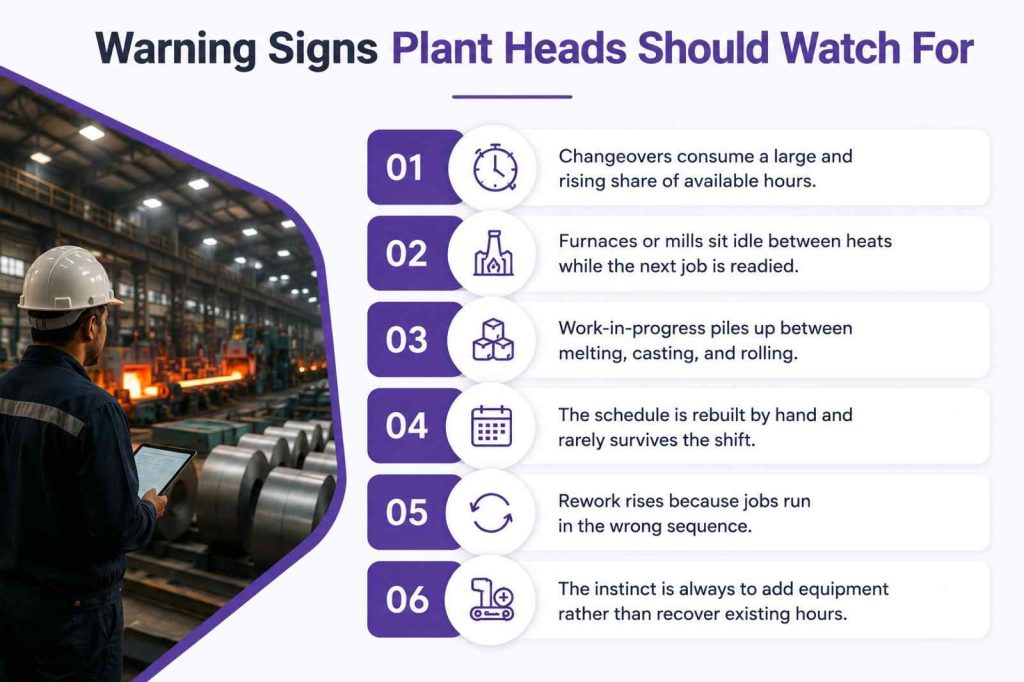
- Changeovers consume a large and rising share of available hours.
- Furnaces or mills sit idle between heats while the next job is readied.
- Work-in-progress piles up between melting, casting, and rolling.
- The schedule is rebuilt by hand and rarely survives the shift.
- Rework rises because jobs run in the wrong sequence.
- The instinct is always to add equipment rather than recover existing hours.
How Leading Steel Manufacturers Address This Challenge?
Strong plants treat scheduling as a lever on capacity, not just a daily chore. Here’s what happens:
- Sequencing jobs to group similar grades and sections, so the changeover penalty is paid as seldom as possible.
- Aligning material arrivals with the heat schedule ensures that furnaces are not waiting on stock.
- Identifying the true bottleneck and protecting it, since an hour lost there is an hour lost for the whole plant.
- Shorten the gap between disruption and response. When a heat slips or material is delayed, the schedule is updated quickly and the affected orders are flagged, so the plant adapts rather than stalls.
Want to know how much capacity your current schedule is giving away? Schedule an assessment with ERPKaro and talk to a scheduling specialist about your plant.
How Steel Manufacturing ERP Helps?
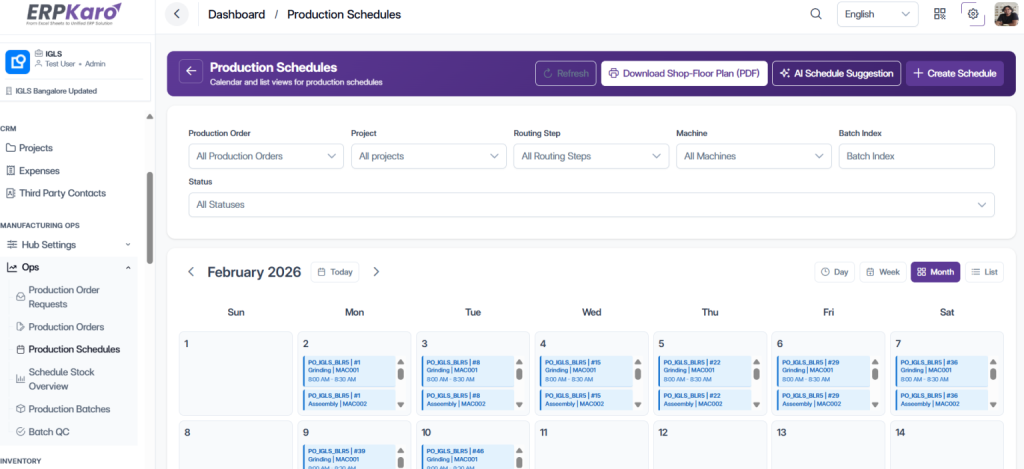
A steel manufacturing ERP builds the schedule from live data on orders, stock, grades, and capacity. It sequences jobs to minimise changeovers, checks that material and capacity support each commitment, and re-plans quickly when a heat or delivery slips. Shop floor visibility shows where work-in-progress is building, so bottlenecks surface early rather than at month-end.
ERPKaro brings production scheduling together with inventory management, MRP, and shop floor visibility for small and mid-sized manufacturers, including steel and metals plants. The result is a schedule that reflects what the plant can actually run, which turns idle and changeover hours back into saleable output.
A Realistic Manufacturing Example
Consider a mid-sized rolling and melting unit struggling to meet demand.
Before: changeovers ate a large share of available hours, furnaces idled between heats, and work-in-progress stacked up between stages.
Problems: the schedule was built by hand and rarely held, grades were not grouped, and management was considering investment in a new furnace to add capacity.
Actions taken: the unit adopted constraint-aware scheduling that grouped similar grades, aligned material to the heat plan, and protected the bottleneck stage.
Results: over two to three cycles, changeover and idle hours fell, effective output rose, and the capital decision was deferred. These figures illustrate the typical pattern, not a guaranteed result.
Key Metrics Every Plant Head Should Track
- Overall equipment effectiveness (OEE)
- Capacity utilization against rated capacity
- Changeover time as a share of available hours
- Furnace or mill idle time between jobs
- Work-in-progress between stages
- Schedule adherence (planned versus actual)
Key Takeaways
Steel plants often lose capacity they already own to scheduling, not to machine limits. Changeovers, idle furnaces, misaligned material, and rework quietly consume hours that could have produced steel. Better sequencing, grade grouping, and bottleneck protection recover much of that lost time, frequently without any new equipment. The warning signs show up in OEE and changeover hours long before they show up in a capital request.
Conclusion
For a steel plant, capacity is the business. Hours lost to poor scheduling are revenue lost at full margin, and the loss grows as the order book widens and the grade mix expands. Adding equipment to solve a scheduling problem only raises fixed costs while the underlying leak continues.
If your plant feels capacity-constrained, schedule an assessment with ERPKaro and book a personalized walkthrough to see how much output better scheduling can recover before you spend on new machines.
Frequently Asked Questions
How does poor scheduling reduce steel plant capacity?
It wastes time the plant already owns. Excessive grade changeovers, idle furnaces between heats, waiting for material, and rework all consume hours that could have produced steel. The machines are capable, but the sequence around them leaves capacity unused every shift.
Why are changeovers so costly in steel manufacturing?
Grade and section changes often require purging, temperature adjustments, roll changes, and quality checks. Each switch costs time and sometimes yield. When jobs are sequenced without grouping similar grades, the plant pays this changeover penalty far more often than it needs to.
Is lost capacity a machine problem or a planning problem?
Usually planning. Many steel plants assume they need more furnace or rolling capacity when the real issue is how existing capacity is scheduled. Recovering idle and changeover time often unlocks meaningful output without any capital spend on new equipment.
How do we measure capacity lost to scheduling?
Track overall equipment effectiveness, changeover time as a share of available hours, furnace idle time between heats, and schedule adherence. Together these show how much of your rated capacity is being lost to sequence and coordination rather than to genuine machine limits.
Can an ERP help a steel plant schedule better?
Yes. A steel manufacturing ERP sequences jobs to group similar grades, checks material and capacity before committing, and re-plans when a heat slips. ERPKaro brings this together with inventory and shop floor visibility so the schedule reflects what the plant can actually run.
Related reading
Curious how much capacity your plant loses to scheduling, not machines? Schedule an assessment with ERPKaro to find the hidden hours in your shifts.