A manufacturing business in the ₹50 to ₹200 crore range sits in an awkward spot. It is too large to run on the owner’s instinct and a morning walk through the plant, yet it often still leans on monthly reports that arrive after the decisions have been made. By the time a month-end pack lands, the late orders have shipped late, the stock mismatch has already triggered an emergency purchase, and the lost capacity is gone. At this size, the question is not whether to measure performance. It is what to measure every single day, and how to see it without waiting for someone to compile a report. A short, reliable set of daily Manufacturing KPIs is what lets an owner act on problems while they are still small.
If you want the numbers that actually run a factory of this size, book a free demo and see how a manufacturing dashboard ERP keeps them live.
Understanding the Problem

Most mid-sized manufacturers lack timely, trusted data on one screen. Numbers are scattered across production sheets, store registers, purchase files, and accounts, each updated on its own schedule. To answer a simple question, such as whether the plant will hit this week’s dispatch plan, someone has to pull figures from several sources and reconcile them.
The result is that decisions wait for reports, and reports lag reality. The owner ends up managing the past instead of the next few days. The root cause is not a missing measurement. It is the absence of a single, live view of the few metrics that decide whether the factory delivers.
Why Poor Daily Visibility Becomes Expensive Over Time
Lagging visibility carries a steady, hidden cost.
- Production impact: a falling capacity or schedule-adherence number spotted at month-end is a month of lost output that cannot be recovered.
- Inventory impact: without a daily accuracy check, mismatches accumulate, driving both over-ordering and stockouts of the same business.
- Procurement impact: late sight of material readiness forces emergency purchases that a daily flag would have prevented.
- Customer impact: an OTIF figure seen only monthly means delivery problems are addressed long after customers have noticed.
- Financial impact: decisions made on stale numbers cost margin in dozens of small ways that never appear as a single line, but add up across the year.
Warning Signs Manufacturing Leaders Should Watch For
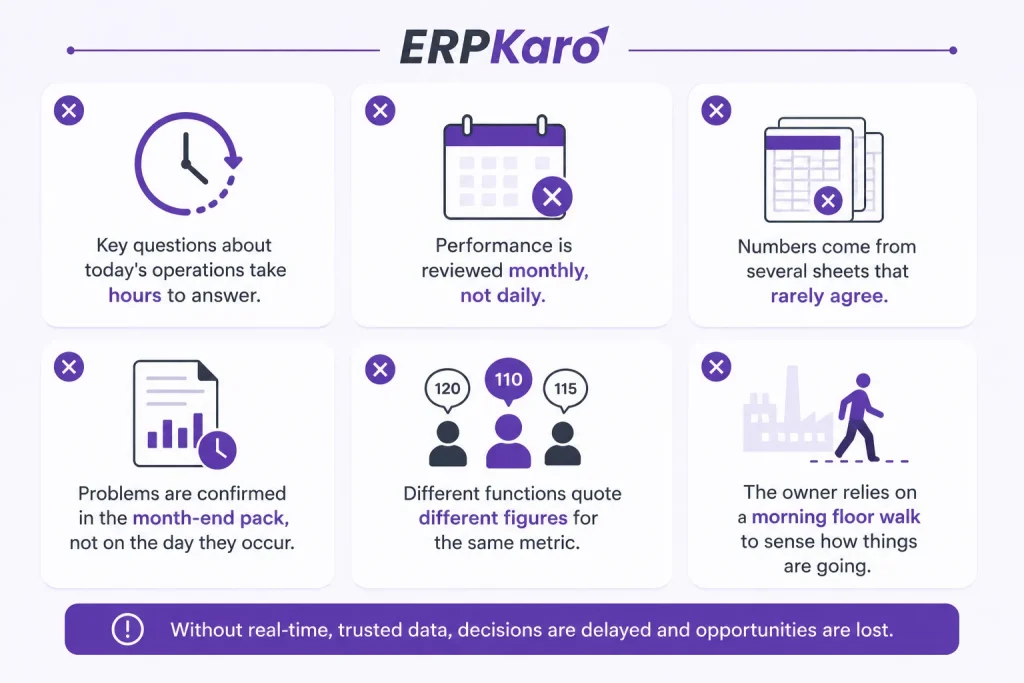
- Key questions about today’s operations take hours to answer.
- Performance is reviewed monthly, not daily.
- Numbers come from several sheets that rarely agree.
- Problems are confirmed in the month-end pack, not on the day they occur.
- Different functions quote different figures for the same metric.
- The owner relies on a morning floor walk to sense how things are going.
How Leading Manufacturers Address This Challenge?
Strong mid-sized manufacturers narrow their attention to a handful of daily KPIs that genuinely drive decisions, and they put those on one screen. They choose metrics that change day to day, such as:
- OTIF,
- schedule adherence,
- capacity utilization,
- inventory accuracy,
- work-in-progress,
- and material readiness
All this, rather than tracking Manufacturing KPIs.
They also insist the numbers come from live operations, not manual compilation, so the team trusts them enough to act. When a metric moves the wrong way, they drill into the detail behind it the same day, while there is still time to change the outcome.
Want a ready starting set of daily metrics? Check ERPKaro today.
How Technology and ERP Systems Help
A manufacturing dashboard ERP draws KPIs straight from live production planning, inventory, and shop floor data and shows them on one screen. OTIF, capacity, stock accuracy, and WIP update as work moves, so the owner sees the factory as it is, not as it was last month. When a number dips, the system supports a drill-down to the order, item, or machine behind it.
ERPKaro brings production planning, inventory management, MRP, and analytics into one system for small and mid-sized manufacturers, with a dashboard that surfaces the daily numbers that matter. The point is not more reports. It is fewer, faster decisions made on data the team can trust.
A Realistic Manufacturing Example
Consider a manufacturer near the middle of the ₹50 to ₹200 crore range running on monthly reporting.
- Before: the owner reviewed a month-end pack, daily questions took hours to answer, and functions quoted conflicting figures.
- Problems: delivery and stock issues were confirmed weeks after they began, emergency purchases were common, and lost capacity was discovered too late to recover.
- Actions taken: the business defined a short daily KPI set covering OTIF, schedule adherence, capacity, inventory accuracy, WIP, and material readiness, and put it on a live dashboard.
- Results: over two to three cycles, problems were caught the same day, emergency purchasing fell, and OTIF improved. These figures illustrate the typical pattern, not a guaranteed result.
Key Manufacturing KPIs Every Manufacturing Leader Should Track Daily
- On-time-in-full (OTIF) delivery
- Schedule adherence (planned versus actual)
- Capacity utilization against rated capacity
- Inventory accuracy (physical versus system)
- Work-in-progress levels by stage
- Material readiness for the next day’s plan
Key Takeaways
A ₹50 to ₹200 crore manufacturer is too big to run on instinct and too fast to run on monthly reports. The answer is a short set of daily KPIs, drawn from live data, on one screen.
- Track OTIF,
- schedule adherence,
- track capacity,
- monitor inventory accuracy,
- check WIP,
- material readiness
Fewer, trusted metrics beat exhaustive reports that arrive too late to matter.
Conclusion
At this scale, the gap between what happened and what the owner can see decides how fast the business can respond, and that gap only widens as volume and product range grow. Monthly reporting that worked at ₹20 crore quietly limits a ₹150 crore business, one missed signal at a time.
If daily questions about your factory still take hours to answer, download the ERPKaro KPI template and book a personalized demo to see how a manufacturing dashboard ERP keeps the numbers live.
Frequently Asked Questions
Why should a manufacturer track KPIs daily instead of monthly?
By month-end, problems have already cost output and margin. Daily KPIs catch a falling OTIF, a stock mismatch, or a capacity dip while there is still time to act. A ₹50 to ₹200 crore business moves too fast for monthly reports to drive decisions.
What are the most important daily KPIs for a mid-sized factory?
Start with OTIF delivery, schedule adherence, capacity utilization, inventory accuracy, work-in-progress, and material readiness. These six show whether you can deliver, whether the floor is running to plan, and whether stock and material support tomorrow’s production.
How many KPIs should a daily dashboard have?
Few enough to read in two minutes. Six to ten well-chosen KPIs beat fifty noisy ones. Pick the metrics that change daily and drive decisions, show them on one screen, and let people drill into detail only when a number moves the wrong way.
Do I need an ERP to track daily KPIs?
You can start in spreadsheets, but they go stale and depend on manual updates. A manufacturing dashboard ERP pulls KPIs from live production, inventory, and order data, so the numbers are current and trustworthy without someone compiling a report every morning.
What is a manufacturing dashboard ERP?
It is an ERP that surfaces live operational KPIs on one screen, drawn from production planning, inventory, and the shop floor. Instead of waiting for monthly reports, an owner sees OTIF, capacity, stock accuracy, and WIP as they change, and can act on the same day.
Related reading
Want the daily numbers that actually run a factory? Download the ERPKaro KPI template and see how a manufacturing dashboard ERP keeps them live.