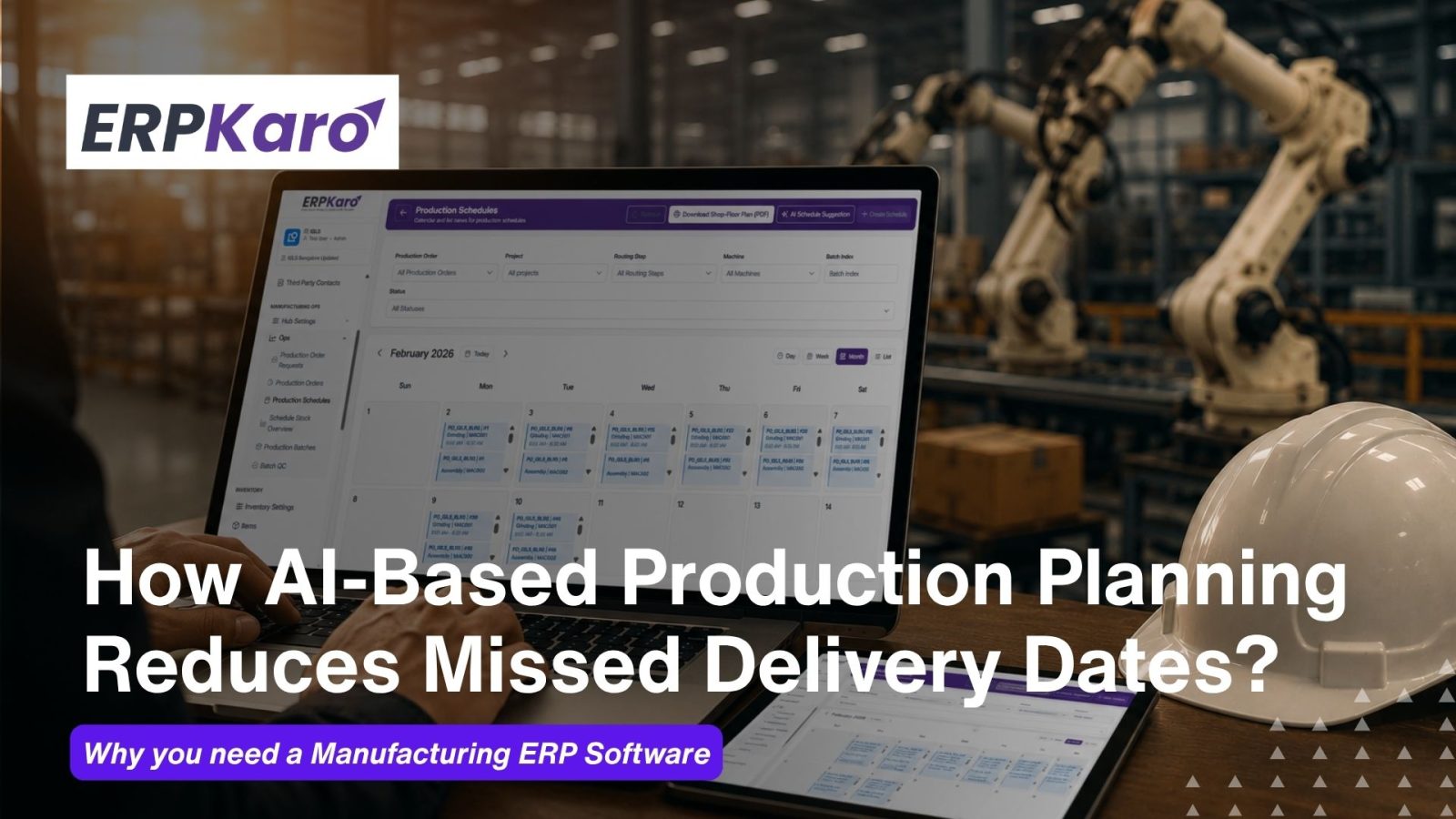
A missed delivery date rarely starts on the day it is missed. It starts weeks earlier, when a date is committed on optimistic assumptions and an incomplete view of the floor. By the time material runs short or a machine is double-booked, the schedule has no room left to recover, and the order ships late. Let us walk you through how AI-Based Production Planning reduces missed delivery dates.
For a production manager, this is one of the most frustrating patterns in the factory. The team works hard, machines run, yet the order book still slips. The cause is usually not effort. It is that the plan was never realistic to begin with, and nothing flagged the conflict in time to act.
If late orders keep happening despite a busy floor, watch a demo of ERPKaro AI production planning to see how realistic dates are built and protected.
Understanding the Problem of Missed Delivery Dates
Traditional production planning is built by hand, usually in spreadsheets, on data that is already a day or two old. A planner sequences jobs based on what they believe is in stock, what they think the machines can take, and when they hope material will arrive. Each assumption is reasonable. Together, they produce a plan that looks fine on paper and breaks on the floor.
The deeper issue is that a manual plan cannot keep up with change. The moment a material delivery slips, a machine goes down, or a rush order arrives, the whole sequence needs reworking. By the time the planner catches up, the situation has moved again. The plan is always chasing reality rather than guiding it.
Consider how this plays out in practice. A planner promises a delivery date, assuming a key material is on hand and the main machine is free that week. In reality, the material arrives three days late, and the machine is held by a rush order from another customer. Neither fact was visible when the date was promised, so the commitment was broken before work even began. Multiply that across dozens of orders, and the order book slips week after week, not because anyone failed, but because the plan never reflected what the floor could actually do.
Why Missed Delivery Dates Become Expensive Over Time?

The cost reaches well beyond the late order itself.
- Customer impact: missed dates erode trust. Buyers begin padding their own lead times or splitting orders to other suppliers, which shrinks the order book.
- Production impact: constant rescheduling causes more changeovers, idle time, and expediting, all of which cut effective capacity.
- Inventory impact: to defend against shortages, teams over-order, raising carrying cost while fast movers still run short.
- Procurement impact: broken plans force emergency purchases at premium prices to rescue a slipping job.
- Financial impact: penalties, expedited freight, overtime, and lost repeat business all compress margin, often without anyone tracing them back to weak planning.
Warning Signs Production Managers Should Watch For
- Delivery dates are committed before material and capacity are confirmed.
- The schedule is rebuilt manually almost every day.
- Shortages and machine conflicts surface on the line, not in planning.
- Expediting and overtime have become routine rather than exceptional.
- On-time-in-full delivery is falling even as the floor stays busy.
- Customers have started padding their lead times with you.
How Leading Manufacturers Address This Challenge?

Strong delivery performance starts with realistic commitments. Leading manufacturers check material availability, capacity, and dependencies before a date is promised, not after. They sequence jobs to reduce changeovers and protect bottleneck machines. They build a little slack into the plan so a single delay does not collapse the whole week.
Just as important, they shorten the loop between disruption and response. When material slips or a machine stops, the plan is updated quickly and the affected orders are flagged at once, so the team acts on hours of warning rather than discovering the problem on the line.
Want to see realistic, constraint-aware planning in action? Watch a demo of ERPKaro and see how dates are committed only when the factory can keep them.
How Technology and ERP Systems Help?
AI-based production planning weighs orders, stock, capacity, and lead times together and generates a schedule that respects real constraints. Before a date is confirmed, the system checks whether the material and capacity actually support it. When something changes, it re-plans in minutes and highlights the orders at risk, so a production manager can act early.
ERPKaro brings AI-powered production planning together with inventory management, MRP, and shop floor visibility for small and mid-sized manufacturers. Because planning, stock, and the floor share one record, the schedule reflects reality, and delivery dates become commitments the factory can keep rather than hopes it might.
A Realistic Manufacturing Example
Consider a mid-sized sheet metal fabricator committing dates from a manual weekly plan.
Before: on-time-in-full delivery sat near seventy percent, the schedule was rebuilt by hand daily, and shortages were discovered on the line.
Problems: rush orders broke the sequence, expediting and overtime were constant, and two customers had begun splitting orders to other suppliers.
Actions taken: the fabricator adopted constraint-aware planning that checked material and capacity before promising dates and re-planned automatically when disruption hit.
Results: over two to three cycles, on-time-in-full delivery improved meaningfully, changeover-driven idle time fell, and expediting dropped. These figures illustrate the typical pattern, not a guaranteed result.
Key Metrics Every Production Leader Should Track
- On-time-in-full (OTIF) delivery
- Schedule adherence (planned versus actual)
- Number of reschedules per week
- Changeover and setup time as a share of available capacity
- Expediting and overtime frequency
- Material readiness at job start
Key Takeaways
Missed delivery dates are a planning problem before they are an effort problem. Dates committed on optimistic, stale assumptions break the moment reality intervenes. AI-based production planning makes commitments realistic by checking constraints before promising, and resilient by re-planning fast when things change. The signs of weak planning appear long before the penalties do.
Conclusion
Delivery reliability is what turns a one-time buyer into a repeat customer. When dates slip, the damage spreads from the late order to the relationship, and it worsens as volume and product mix grow and manual planning falls further behind. The longer planning stays manual, the harder it is to recover the order book that late deliveries quietly cost you.
If late orders persist despite a hardworking floor, watch a demo of ERPKaro and book a personalized walkthrough to see how AI production planning helps you commit to dates you can keep.
Frequently Asked Questions
What is AI-based production planning?
It is planning that uses live data on orders, stock, capacity, and lead times to generate and adjust a realistic schedule automatically. Instead of a planner building a plan by hand on stale numbers, the system weighs constraints continuously and flags conflicts before they become missed dates.
Why do manufacturers miss delivery dates even when the team works hard?
Missed dates usually trace to planning, not effort. Dates are committed on optimistic assumptions, then material shortages, machine conflicts, or rework break the plan. When the schedule cannot absorb these shocks, even a hardworking floor cannot recover the lost time.
How does AI planning improve on-time delivery specifically?
It checks material, capacity, and dependencies before a date is promised, sequences jobs to reduce changeovers, and re-plans quickly when something changes. The result is fewer impossible commitments and faster recovery when disruption hits, which lifts on-time-in-full delivery.
Do we need perfect data for AI planning to help?
No, but you need reasonably accurate stock and routing data. AI planning is most effective when inventory and bills of material are reliable. Many manufacturers improve data accuracy and adopt planning together, since the two reinforce each other quickly.
Can a small manufacturer use AI production planning?
Yes. Tools like ERPKaro bring AI-powered production planning to small and mid-sized manufacturers with fast implementation. A focused rollout covering planning and inventory often improves delivery reliability well before a full ERP project would.
Related reading
Want to see how AI planning turns delivery dates into commitments you keep? Watch a demo of ERPKaro production planning built for Indian manufacturers.